By Find My Sexy · July 8, 2026 · 9 min read
I Don't Know What Turns Me On Anymore
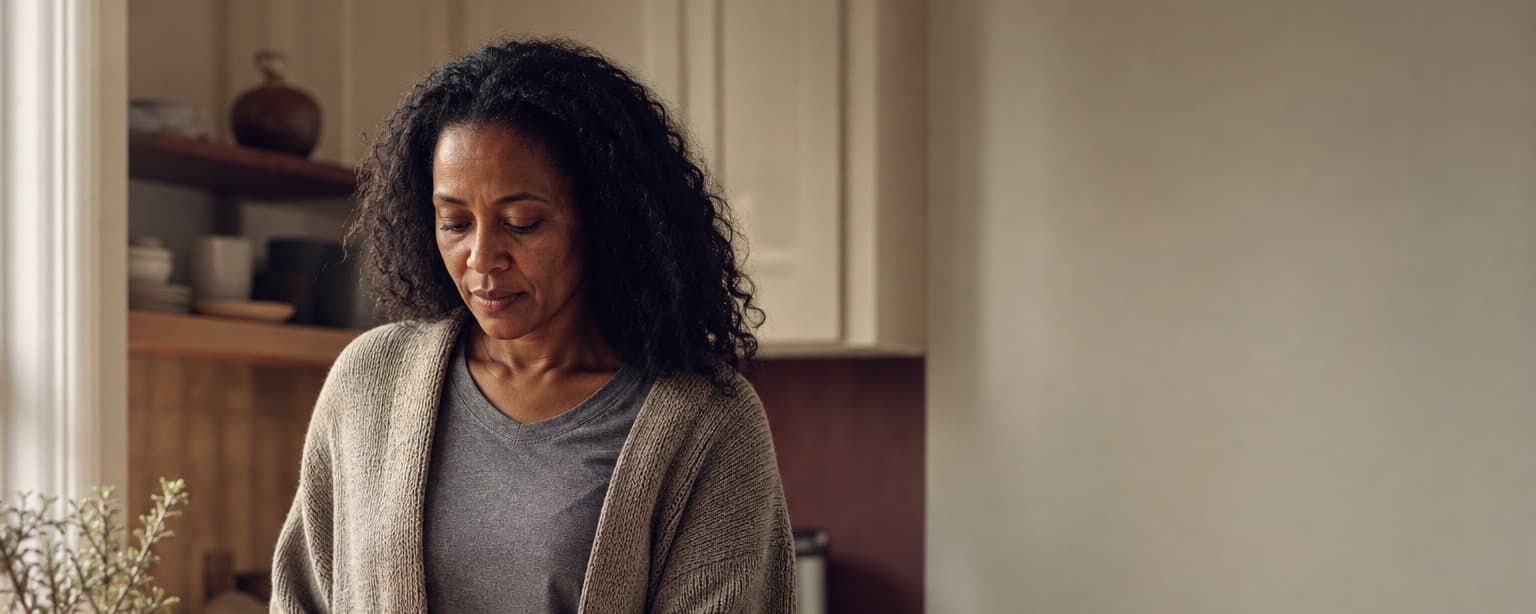
You are lying there with enough privacy, enough time, and maybe even someone you love nearby. Nothing is technically wrong. But when you ask yourself what would actually turn you on, the room goes blank. The old answers feel stale. The new ones do not appear.
That blankness can be frightening, because it sounds like a verdict. A woman who used to have preferences now feels like she is guessing from memory. She can remember what used to work. She just cannot feel the pull toward it.
If this is where you are, the problem is probably smaller and more specific than it feels. You have not lost the whole map of desire. You have lost access to the signals that tell you where the next step is.
The question underneath the question
"I don't know what turns me on anymore" sounds like a question about sex. Often it is a question about contact with yourself. What do you notice? What catches your attention? What makes your body move half an inch closer without asking permission from your head?
Those are small signals. They are easy to miss when life has trained you to scan for everyone else's needs first. A 44-year-old running a household and a job is already tracking too much. Add a relationship and three invisible calendars, and tiny personal signals get very little airtime.
So the loss can feel sexual, because sex is where it finally becomes obvious. But the thinning began earlier. It began in the daily habit of overriding your own appetite, tiredness, boredom, irritation, curiosity, and need for space.
By the time the bedroom asks, "What do you want?" the system has been practicing "I don't know" all day.
Why the old answers stop working
Most women are given a very narrow idea of turn-ons. A certain kind of touch. A certain look. A certain scene. A certain version of themselves who is relaxed, confident, and apparently free from laundry.
That version can become useless in midlife, because the body and context have changed. The same music, kissing, clothes, or fantasy may not land the way it did at 28. And forcing it to land can make the blankness louder.
This is especially true in perimenopause, when sleep, mood, skin, temperature, and stress tolerance can all shift. Desire does not sit apart from those changes. It arrives through the same body that is waking at 4am and snapping at the dishwasher noise.
There is also the long-relationship piece. Emily Nagoski's work on brakes and accelerators is useful here. Desire depends on what presses the accelerator. It also depends on what has a foot on the brake.
Pressure is a brake. Obligation is a brake. Pain memory is a brake. Feeling watched is a brake. So is the private knowledge that if you show one small spark, it may be treated as a promise for more than you meant.
Under those conditions, the body often does something very sensible. It stops sending clear invitations. A signal that cannot be safely followed may go quiet instead.
Turn-ons are usually quieter than people think
The culture makes turn-ons sound dramatic. Instant heat. Obvious fantasy. A switch flipped. That exists for some people, some of the time. But it is a poor model for a lot of women in long relationships.
Responsive desire often starts with almost nothing. A slight softening. A little curiosity. A willingness to stay with a sensation for ten more seconds. The wanting may come after the body has already been treated kindly.
That means the first signs may not feel sexual at all. Warm water on your hands. The weight of a jumper against your waist. The private relief of closing a door. A song in the car that makes you remember your body has hips.
These moments matter because they are your attention turning back toward sensation. Lori Brotto's research on mindfulness-based sex therapy points in the same direction. Women often recover desire by learning to notice sensation without judging it, rather than by trying to manufacture more sexual thoughts.
The clinical word for this body-sensing capacity is interoception. You do not need to use the word in daily life. But you do need the capacity, because desire needs some route back through the body.
The reframe: you are looking too late
Most women try to answer this question at the point of pressure. In bed. During kissing. After a partner has already asked. When something is meant to happen next.
That is a hard place to listen. The stakes are already too high. Your attention is split between what you feel and what he might expect. It is also tracking what happens if you say no.
So the useful reframe is simple. Do not start by asking what turns you on in a sexual moment. Start by asking what makes you turn slightly toward life when nobody is asking anything from you.
That might sound too small. It is not. The same pathway that lets you register pleasure in the ordinary body is the pathway that later lets erotic pleasure register. If that pathway has gone quiet, explicit sexual effort can feel like shouting into a disconnected phone.
This is where dopamine can be relevant. It is part of wanting and reaching toward. Chronic stress and poor sleep can thin that reaching feeling, so the mind remembers desire better than the body can create it.
Again, this is state. It is not a personality change. A flat signal can become clearer when the conditions change.
One small way to begin
For seven days, do not try to find a sexual turn-on. That is the whole point. Give your body a week without being tested for desire.
Instead, once a day, catch one moment of non-sexual pull. Not pleasure you think you should enjoy. Not gratitude. Not a wellness ritual. Just one tiny, honest movement toward something.
It might be wanting the blue mug instead of the white one. It might be standing in the last patch of sun on the kitchen floor. It might be choosing the shirt that feels better on your skin, even though nobody will notice.
When you notice it, name it plainly. "I want that." "That feels good." "More of that." Keep it small enough that your nervous system does not turn it into another task.
Do not make a list of ten. Do not turn it into homework. One moment is enough. The practice is not to become a sensual genius by Friday. The practice is to prove that your wanting still sends signals when it is not under pressure.
After a week, you may start to see patterns. Warmth. Texture. Privacy. Beauty. Being unobserved. Being seen in a very specific way. Movement. Music. A bit of danger, maybe, though not the kind that costs you safety.
Those patterns are more useful than a generic list of turn-ons. They tell you what conditions help your desire speak.
What to do with a partner
If you are with someone, this question can become loaded fast. A partner may hear "I don't know what turns me on" as "you don't turn me on." Those are different statements.
You do not have to solve that entire conversation tonight. If you need words, keep them narrow. "I'm trying to notice what actually feels good again. I need less pressure while I do that." That is enough for a first pass.
The important part is the pressure piece. If every sign of interest gets treated as a green light for sex, your body may stop offering signs. It needs room for a maybe. It needs room for a yes that stays small.
That room can be very practical. A kiss that does not become a negotiation. A hand on your back with no follow-up question. Ten minutes beside each other where nobody is silently waiting to see whether it turns into more.
This is not about training a partner to be perfect. It is about protecting the early signal from being crushed by expectation.
When the blankness needs more support
Sometimes the blankness is part of something heavier. If you cannot feel pleasure anywhere, if food, friendship, music, rest, and ordinary life all feel flat for weeks, that deserves support. The Words page has a plain entry for anhedonia, and a clinician can help you sort what is going on.
Pain also changes the picture. If touch or sex hurts, the body is not being mysterious. It is protecting you from a known cost. Vaginal dryness, pelvic floor tension, medication effects, and hormone changes are real things. They deserve practical care, not pep talks.
But if what you are feeling is the quieter version, the blank page where preferences used to be, begin there. Begin before sex. Begin before performance. Begin with the first small pull toward anything that feels like yours.
You do not have to know the whole answer yet. You only need one honest signal.
Free
Get the 5-minute starter practice
One email, right now, with a practice you can do today. Plus occasional posts on this work. No spam, unsubscribe anytime.
Get the long-form essays by email: findmysexy.substack.com
Or, if you’re ready, Find My Sexy is the full 365-day daily practice — for women in their 40s coming back to themselves.
Start my practice — €97/year →