By Find My Sexy · June 9, 2026 · 6 min read
Why Does Kissing Feel Like Pressure Now?
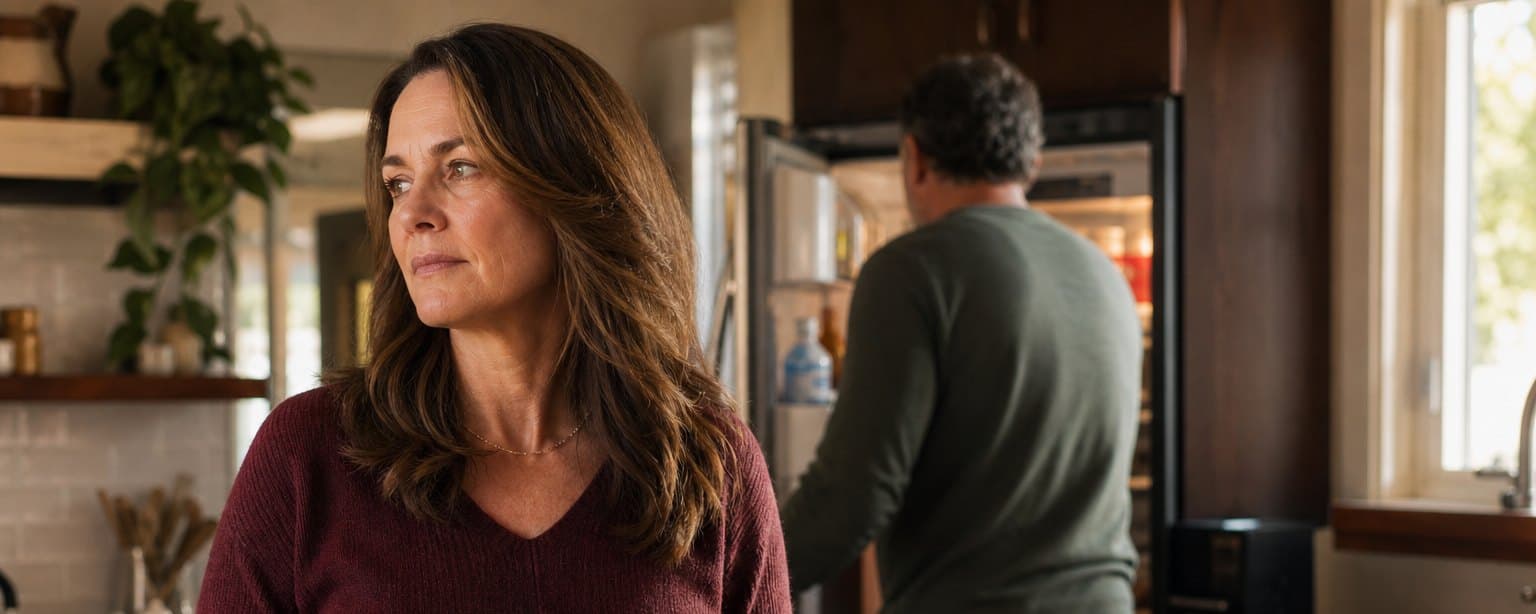
He walks into the kitchen and kisses the back of your neck. Two seconds. Then he heads to the fridge. But something happened in your body before it was over. A small tightening. A held breath. You smiled, turned back to what you were doing, and filed it somewhere under: I don't quite know what to do with that.
The kiss wasn't aggressive. It wasn't a demand. And yet something in you went quiet and careful in a way that's sort of hard to explain.
This is one of those things women don't tend to name because it sounds ungrateful. "My husband kissed me and I tensed up." But it's real, and it's common, and it makes complete sense once you see what the nervous system does with patterns it's been taught.
How a kiss stops being just a kiss
A kiss is just a kiss until it has history. And history builds slowly, without anyone deciding it should.
In early relationships, a kiss exists in open space. It doesn't mean anything particular about what follows. It's warmth, or greeting, or play. But in a long relationship, context accumulates. Where sex has sometimes felt like something she goes along with, where touch often escalates, the kiss starts carrying the whole sequence.
The nervous system is very good at pattern recognition. That's its actual job. So after enough repetitions, it begins to pre-empt. A kiss was followed by more touch. More touch was followed by something she didn't quite choose, and didn't refuse either. The body learned the script. And now before the kiss is over, it's already preparing for what comes next.
This is what Emily Nagoski calls the brakes system doing its job. The system that protects from unwanted experiences isn't misfiring. It learned something. A kiss stopped being context-free and became a first move in a sequence the body has decided to be careful about.
The kiss acquired meaning it wasn't born with. Now it arrives weighted. And the body responds to the weight, not to the kiss itself.
Why this is hard to name
Part of what makes this tricky is that it looks like rejection from the outside. He kissed her. She tensed. He didn't do anything wrong, and she can't explain why she went stiff. So it stays unnamed. He starts to feel like he can't touch her without something going wrong. She feels guilty and confused. And the pattern calcifies.
The other difficulty is the guilt itself. She loves him. She knows a kiss is just a kiss. Why can't she relax into it? But wanting to relax and being able to relax aren't the same thing. You can't override a trained anticipatory response by willing it away. The nervous system isn't listening to that conversation.
This doesn't mean something is wrong with her. It means something has been learned. And things that are learned can be unlearned, slowly, with enough repetition going the other way.
What the body is actually doing
When the autonomic nervous system has learned that a certain touch leads to obligation, it starts activating its protective response earlier and earlier. This shows up as the shoulders going slightly tight during a kiss. Attention leaving the body. Something flat behind the eyes even while the lips are present.
Like how your body starts tensing in the waiting room before the dentist calls your name. The dentist hasn't done anything yet. But the prediction is already running, and the body is preparing for it.
The brakes system isn't broken here. It's accurate. It learned the pattern correctly. But it learned one version of what a kiss leads to. Now it runs that version on every kiss, regardless of what this particular kiss actually is.
What the kiss needs to become
The kiss needs to be decoupled from the sequence. That's the structural thing. And it can't happen entirely inside one person. But it can start there.
The first move is recognizing what's happening, without judgment. Not "I can't even accept a kiss anymore," which is a story and not a very accurate one. But: my body has associated this with what follows, and it's pre-loading a response. That's information about the pattern. It isn't a verdict on the marriage.
The second move is something small and deliberate. Not a big conversation, not a negotiation. Just an internal decision: this kiss at the door is a kiss at the door, and that's all it is right now. An experiment in staying present for the two seconds it lasts, rather than bracing against what might follow.
The body is slow to update. The first few times, the old alert will probably still go off. That's expected. The nervous system is running the old prediction because it hasn't collected enough new data yet. The new data is exactly this: sometimes a kiss is just a kiss, and nothing follows it that she didn't choose.
One thing to try
There's a practice that researchers who work with couples sometimes call non-demand kissing. It sounds almost too simple. The idea is that some kisses are agreed to be complete in themselves. Not every kiss, not a rule.
Just specific ones: a morning kiss before coffee, a goodnight kiss where both of you turn over. Moments where the kiss is the thing, not the start of something else.
What this does, over time, is give the nervous system new data. The kiss-as-obligation pattern wasn't learned through one big moment. It accumulated through many small ones. So the update has to come through many small ones too. Kisses that happened, and then nothing. Kisses that didn't mean the next thing.
The hard part isn't the kiss itself. It's staying present in it rather than going somewhere else to manage the anticipated future. That requires attention, and attention is what's been depleted. But even a few seconds of actual presence in a kiss feeds the nervous system something different. A bit of warmth without a bill attached.
The wider context is worth looking at too
If kissing has gotten complicated in this way, it's usually a signal about everything around it, not about the kiss itself. The kiss lives inside all of it. The obligation history, the tiredness, the touch that's been hard to receive, the intimacy that sometimes felt more like duty than choice.
That wider pattern has its own work. But the kiss is a concrete place to start, because it's small enough to experiment with, and specific enough that the results are noticeable.
The goal isn't to perform enthusiasm. It's to restore something real: the ability to be physically present with someone without the body going into management mode. That's worth having on its own terms, separate from anything that follows.
If avoidance has spread beyond kissing, why do I avoid intimacy with my husband looks at the three patterns that usually drive it.
Free
Get the 5-minute starter practice
One email, right now, with a practice you can do today. Plus occasional posts on this work. No spam, unsubscribe anytime.
Get the long-form essays by email: findmysexy.substack.com
Or, if you’re ready, Find My Sexy is the full 365-day daily practice — for women in their 40s coming back to themselves.
Start my practice — €97/year →